Fulfilling my obligations to my long-neglected TBR one book a time. Want to know why? I explain it in the first post here. Posting striking lines daily on BlueSky
This week’s book may end up being one of my favourite books of the year. But, and I need to say this right up front, not because of the poetry, but because of the conversation on cultural appropriation that it opens up. I’m not terribly surprised by that I like the poetry in this book. Fred has long been one of my favourite Canadian poets. I have been reading him since I discovered poetry in the 80s. And while I own much a bunch of his bibliography, this book wasn’t part of my collection until I stumbled across it at Porch Light Books in Edmonton. Once again, if you’re in the area, you have to stop in!
Last week’s post was about ekphrastic. This week’s post is also about that, but also about more. The titular pictograms are images taken from a book by John Corner called “Pictographs (Indian Rock paintings) in the Interior of British Columbia” (Vernon, 1968). Fred writes poems “interpreting” the images. The only gloss on the text he provides is a quote at the beginning of the book from Coleridge (that’s leaning on the height of colonialism) in “Literary Reminiscences” which reads:
“Not the qualities merely, but the root of the qualities is transcreated. How else could it be a birth, – a creation?”
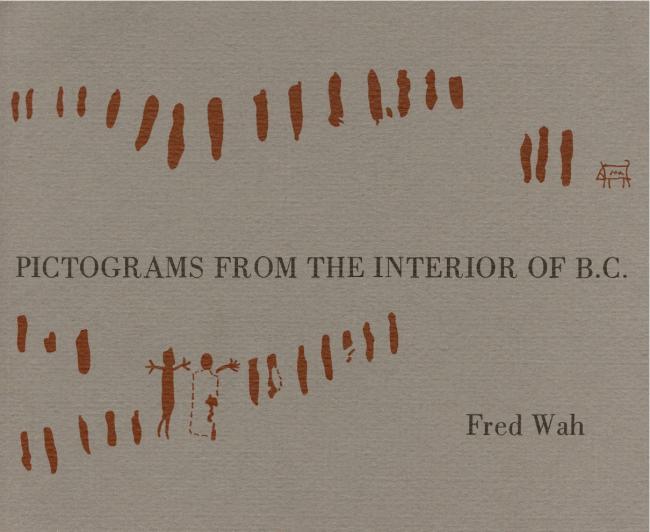
So, Fred is “transcreating,” bearing something new into existence from something previous?
This pisses me off. The poetry in the book is good, great even in places. It could stand on its own. “Pictographs” was published in 1975, long before the concept of cultural appropriation entered mainstream dialogue. It is a textbook example of how the colonial Canadian mainstream, the institutions, the ivory tower, ignored (and continue to ignore) traditional culture and knowledge, choosing instead to re-colonize it. If you are not familiar with the complex snarl of issues of cultural appropriation, fire the term into your favourite search engine and go to town. The key concept is using cultural references without consent. Simple, right? If it’s not yours, ask.
So, what would this book have looked like if Fred had partnered with indigenous knowledge keepers from the different nations whose work is featured in Corner’s original book? What masterpiece could have been?
If you follow me over on BlueSky you already know that I post lines I find striking every day as I slowly read through one book or issue each week. I am not going to include a quote this week. I am going to leave that book where it is and leave space for voices that have been left out. This is what is driving my creativity this week:
Not about us without us.


 Paul Pearson
Leave a comment