Fulfilling my obligations to my long-neglected TBR one book a time. Want to know why? I explain it in the first post here.
After last week’s “I’m reading a book that has been on my TBR for all of 2 days” post, I imagine you rolling your eyes at the premise of this blog series and its so-called “long-neglected” To Be Read list. Well, dear reader, I got you. This week you see what I really mean by long-neglected.
I bought Ian Williams’s “Personals” hot of the presses in 2012. Yes, you read that right, 13 years ago. Back when personal ads in newspapers were still a thing. Seriously, how dated am I? I am a truly horrible person, not only for letting this slim volume languish for more than a decade but for the fact I was only motivated to pick it up after one of my Olive co-editors read a poem from this book at an open mic in December. Thanks for the inspiration Colby!
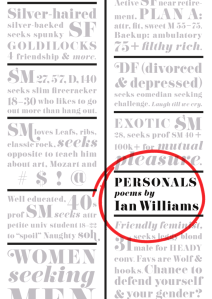
I had read about this book of course. It was very popular when it was released and is apparently still widely taught. In particular, reviewers talk about the opening sequence of (sort-of) sonnets and how the last line in each is formed into a circle or a ring, the words eating their own tail like an ouroboros circling itself with neither end nor beginning. It’s a clever device that works more effectively in some poems than others – most effectively in the opening poem, ‘Rings.’
Problem is our armpits and crotches are feathered / with cobwebs. Problem is she leaks soft-boiled eggs / or I package seedless grapes…
Holy moly! And the final line circling in an endless ring:
“the problem is we don’t know who”
Powerful stuff. I was not expecting the first poem I read on Monday morning to be an absolute gut-punch meditation on infertility.
I refer to this opening sequence as ‘sort-of sonnets’ because while numerous reviews call them sonnets, they’re not. Not really. The poems all do have 14 lines, including the last ring line, but that’s as sonnet as they get. The line lengths vary, there is no rhyme scheme, the structure doesn’t follow any of the myriad sonnet varieties that have cropped up over the centuries. And, most importantly in my opinion, is the rhythm, or lack thereof. The meter in these poems is not structured by foot but by anaphora. This is where the poems draw their power.
I am a big fan of anaphora. Used right it can be the relentless motor driving a powerful rhetoric. I’ve written a few sequences using the technique though always structuring my lines to start with the anaphora and keeping the line lengths relatively even to generate a kind of loping, steam engine-y rhythm.
Here, Williams prioritizes line lengths, keeping within a syllable or two of the sonnet’s usual 10 beats, rather than keeping each line a complete phrase which means the repetition of the anaphora happens randomly over the page. Each anaphoric phrase is also a different length so the result is a very uneven rhythm that seems to lurch and cough in fits and starts like the exact opposite of a motor. More like a drunk stumbling down a flight of stairs.
But what a drunk! These poems hit hard. And while the final ring line structure doesn’t quite work perfectly every poem, the effect is intoxicating. This first section of the book alone is worth tracking down a copy if you don’t already have one languishing on your TBR pile.
There are numerous reviews of “Personals” online which get into other aspects of the book. This post is already longer than my usual so I’ll wrap things up with a couple of final thoughts. Is this book worth buying and reading? Yes! is this book perfect? No. While there are a number of really interesting lines and images and thoughts, there are also a few too many gimmicks, for lack of a better word. There are some truly beautiful and/or arresting poems in this book. In addition to the anaphora, I am also struck by the dialogic approach Williams uses in fits and starts across the book. And I guess it is that uneven approach, that feeling of a lacking cohesiveness that dampens my enthusiasm somewhat.
When I listen to music I prefer to listen to the whole album rather than just the singles. Same goes for poetry. I find I prefer books that present a kind of meta-narrative across the collection rather than those books that are a collection of separate pieces that happen to be written by the same author.
Does that make sense? How do you like to read poetry?


 Paul Pearson
Leave a comment